 6 tips to get wedding guests to RSVP on time
By Frankie David · May 29, 2026
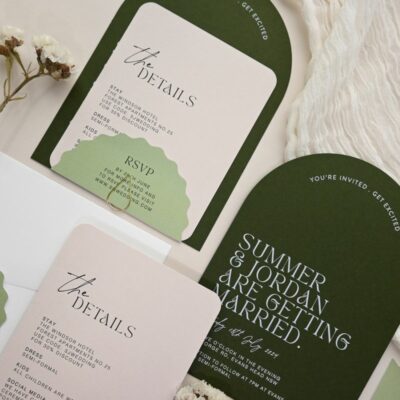
These are individual choices, but one thing to always bear in mind is that the wedding invitation can set the tone for the occasion. Some couples will consider it a visual prelude to the styling, tone, and mood of the wedding itself.
Before you send out save the dates and invites, make sure you’re signed up for Easy Weddings to keep on top of all your planning.
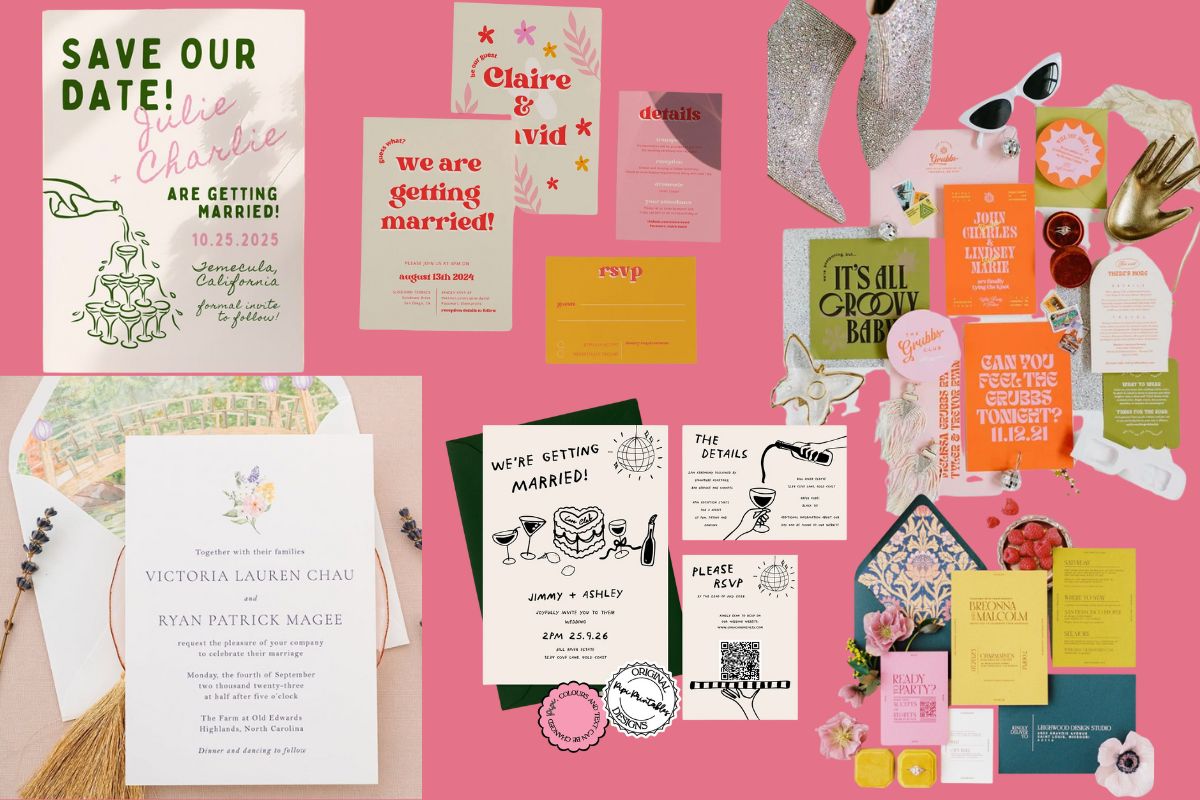
A formal wedding generally requires traditional wording on the wedding invitations, whereas a less formal affair is better suited to modern wording. Here are some examples of wedding invitation wording to help guide you.
Don’t forget to include the RSVP details!
If you can, keep your invitation wording brief. This will keep costs down and ensure your invitations are clear and straight to the point.
If you include too much information on the invitation, you run the risk of having important details missed by guests. If your invitations include too many separate cards (RSVP cards, save the date cards, menu samples, poems, readings etc.) parts of the invitation may be misplaced by guests and therefore important details may be lost.
That said, invitations that are too brief may not include all the necessary details and information. Creating a wedding website to work alongside invitations can be used for any additional information left off the cards, such as menu examples and music requests.
Keep this in mind when designing your invitations and ordering them with your chosen supplier.
Browse our wedding invitation suppliers.
Traditionally, wedding invitations should be sent three months prior to the wedding day.
If you are using a wedding invitations business or supplier to produce your invitations they will help guide you as to when you should begin delivering your invitations, however, many modern couples opt to send their wedding invitations out two months before the wedding day.
But if you’re wanting to make sure your guests can make it – always send out some save the dates as well.
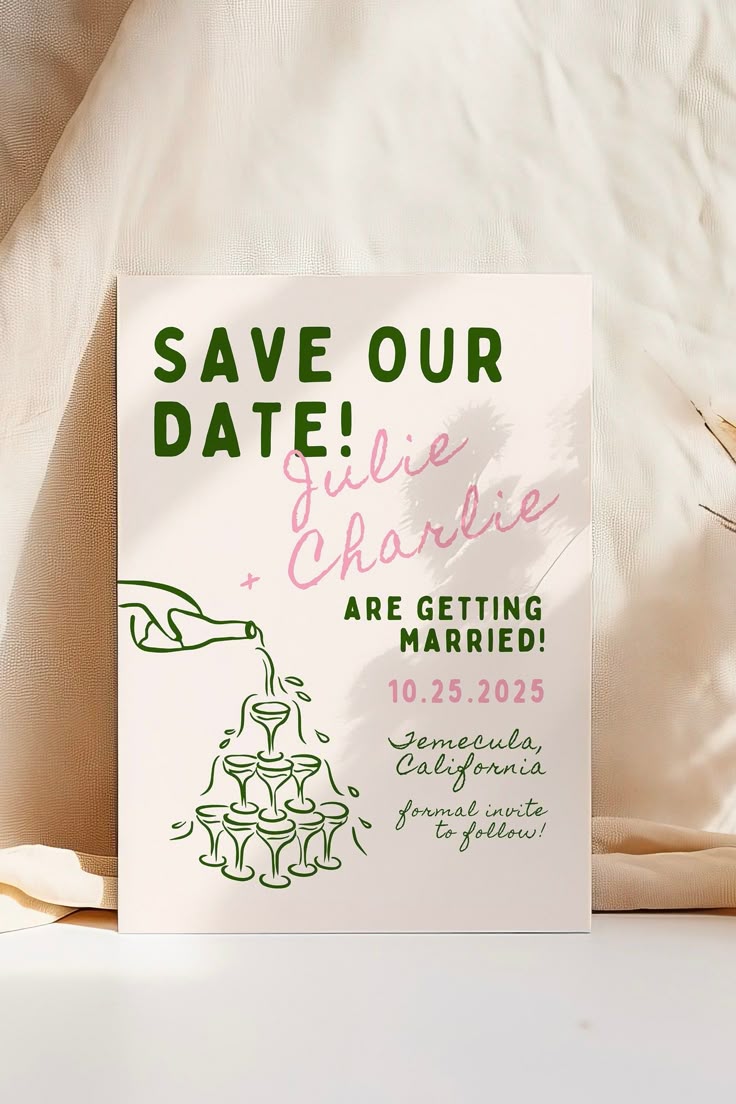
Don’t forget to save the date! Your guests will need to block out calendar space. Source: Good Times Collective Co.
Some people prefer to hand deliver all their wedding invitations, so if you or your future-spouse fall into that category you will need to allow ample time to hand deliver your invitations to the homes of all your guests. But, keep in mind, this is a pretty old tradition and if you don’t have the time nor the resources, it’s a little unnecessary.
When you have guests that are travelling from overseas, invitations may go out up to 12 weeks in advance. Bear in mind, however, that if guests living overseas are close family, they will be aware of the date well in advance (as most people are these days!) and receiving the wedding invitation is merely a formality.
If you are having a formal, traditional wedding, you may find that traditional wording will be more suitable for your wedding invitations. Using traditional wording will create a cohesive tone for your wedding and will also insinuate to your guests that your wedding will be a formal, rather than casual, affair.
Very traditional weddings are often invited ‘from’ the bride’s parents. This dates back to the bride’s side of the family traditionally footing the bill. But if you’re splitting costs, you can still stick to this tradition. Or, lightly modernise it by including the other partner’s parents on the invitation too.
Tradition meets modern, with this traditional wording but modern colour palette. Let your invitation be the precursor to your vibe.
Super traditional wording is based on the notion that the brides’ parents are the hosts and therefore pay for the entire wedding.
If this applies to you, here is an example of an invitation of the most traditional kind (whereby only the bride’s parents, as host, announce the wedding) would appear as follows:
Mr & Mrs Anthony Alexander Smith
cordially invite you to attend the
wedding ceremony
of their daughter
Mary Jane Smith
to
Andrew Scott Cross
Followed by the details: ceremony location, time, formal celebration (reception) after.
These days, however, traditional invitations need not be so implicitly defined. Most frequently, the groom’s parents appear on the invitation, even though they are not ‘hosting’. This is really a gesture of general courtesy in an attempt to recognise both sets of parents.
On such an occasion, the invitation would appear as follows:
Mr & Mrs Anthony Alexander Smith
cordially invite you to attend the
wedding ceremony
of their daughter
Mary Jane Smith
To
Andrew Scott Cross
son of Mr & Mrs John Reginald Cross
Alternately, parents of both the bride and groom may host the wedding, in which case, they are each addressed appropriately. Such an invitation would appear as follows:
Mr & Mrs Anthony Alexander Smith
together with
Mr & Mrs John Reginald Cross
request the honour of your presence to witness the marriage of their children
Mary Jane Smith
and
Andrew Scott Cross
If your looking to cut back your word count, then an alternative is to start it with “The families of… [Partner 1] and [Partner 2]…”
Traditional invitations are a beautiful keepsake and a wonderful way to lightly inform your guests of what’s to be expected from the day.
Many modern wedding invitation wording variations do not cite the parents at all – especially if the bride and groom are paying for their wedding. In this context, it is the bride and groom that ‘announce’ the wedding.
Many modern couples opt to have their ceremony and reception at one location which means there is less wording needed on the invitation. Current trends are also headed towards mixing capital letters with lowercase, and using different fonts too.
Here is an example of a modern and simple approach to wedding invitation wording:
MARY & ANDREW
ARE GETTING MARRIED!
SUNDAY THE SECOND OF OCTOBER 2025
Ceremony/reception name
At 1:00 PM
Ceremony/reception address
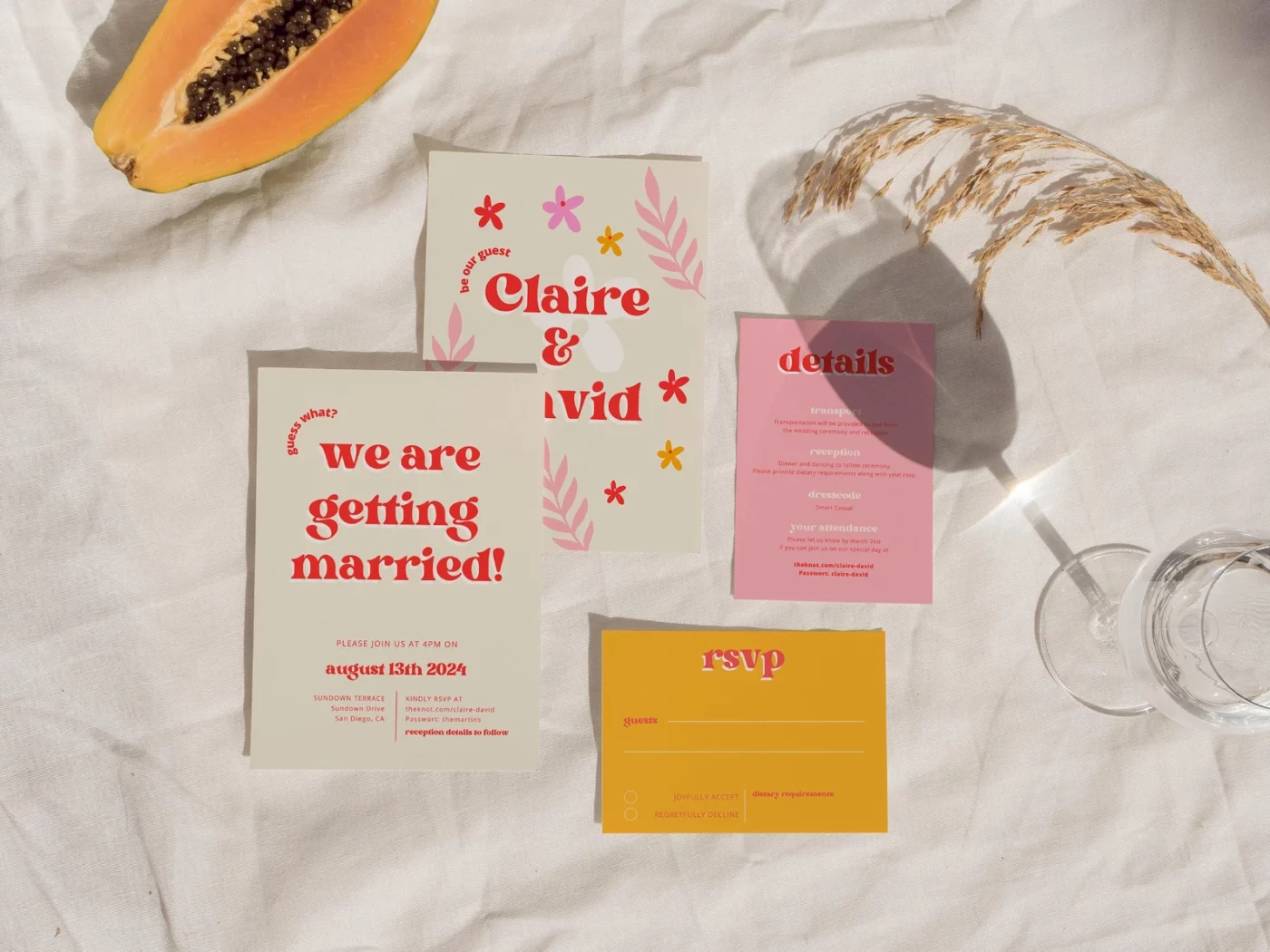
Modern invites can get straight to the point! Source: Moontide Memories.
Modern couples sometimes opt to include a dress code on the invitation if they are not using traditional wording (as traditional wording usually implies a dress code). Couples may include the RSVP date on the invitation if they wish. Traditionally, an RSVP card is included with the invitation in an envelope, however, no mention of the RSVP is included on a formal invitation. This style of invite will include all the details, from the night before, the day of the wedding – the timeline, and also suggestions on where to stay, where to be.
Some invites leave nothing up to chance.
For some couples, if you have a strong theme to your wedding – Western, garden party, old romantic – your wedding invite can be the first taste of this. Design your invites to complement your colour palatte or theme, and give your guests a sneak peek into the festivities.
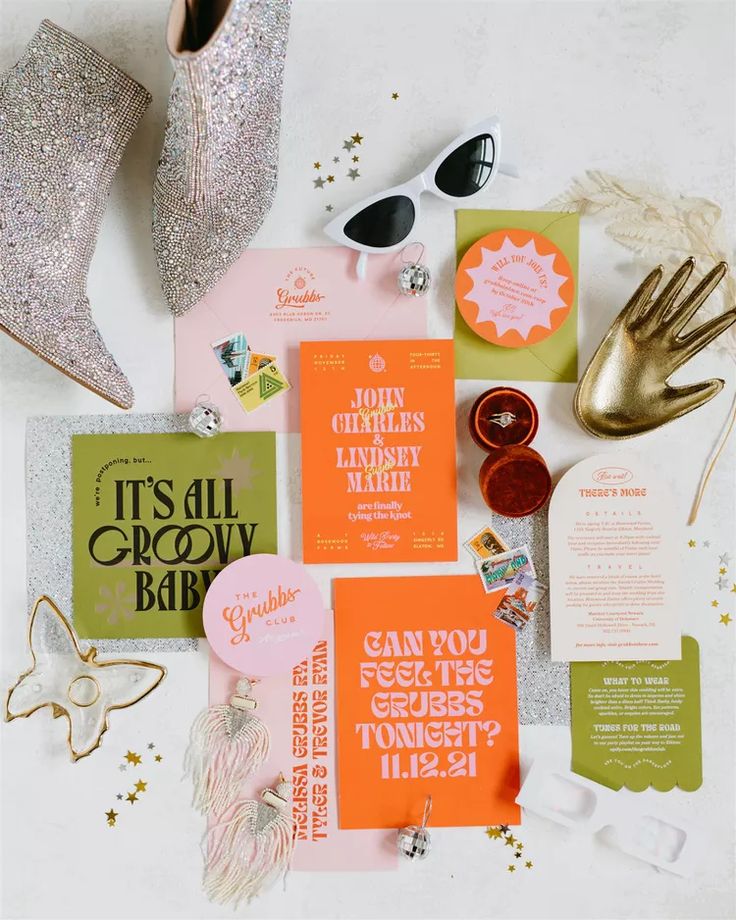
Treat your wedding invite like a teaser to your theme. Source: Hannah Baldwin.
Before ordering your wedding invitations, we recommended shopping around to find the perfect supplier to match your wedding theme and style. There’s a number of quirky and unique ways to invite guests to celebrate your wedding – you are not just confined to the traditional invitation and envelope in the mail.
For instance, some couples opt to have paperless invitations. Couples can set up a wedding website to coordinate guests and RSVPs. With this way of inviting guests, you may have to still formally invite those who aren’t as tech savvy or who aren’t active on social media.
The choice depends on the style and tone of your wedding. Formal, traditional wording suits black-tie or classic ceremonies, while modern or minimalist wording works best for relaxed or contemporary celebrations.
The main things to not miss are the couple’s name, the date, the time, the location and the RSVP details. It’s also helpful to include the dress code.
Optional extras like directions, accommodation info, or a wedding website link can also be included.
Traditionally, invitations are sent three months before the wedding, but it’s becoming longer and longer now as lives get busier. Some will send a save the date 12 months prior to the wedding, and then the formal invitations three months prior.
It depends. Traditional invitations often use a separate RSVP card, while modern ones commonly include RSVP details directly on the invite or via a wedding website.
Categories: Wedding Invitations
Tags: invitation wording, wedding etiquette, wedding invitations, wedding stationery
6 tips to get wedding guests to RSVP on time
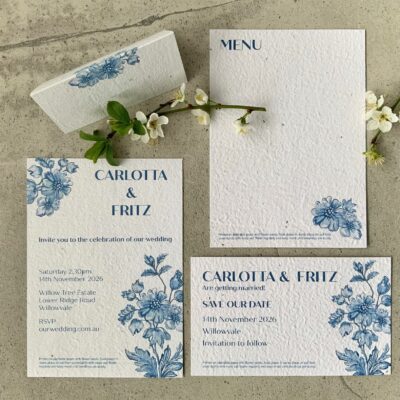 12 wedding invitation ideas we’re loving for the modern couple
 Canva wedding fonts for your invites, website and stationery